Hot Honey vs Chilli Honey: What’s the Difference?
Updated: Sep 20
Pick up one jar labelled hot honey and another labelled chilli honey and you may find two very similar things: honey paired with chilli to give sweetness and heat in the same spoonful. In everyday food writing, the two names are often used for overlapping products. Each one can still create a slightly different expectation about flavour, intensity and how the honey might be used. Understanding that distinction is more useful than arguing that one term is correct.
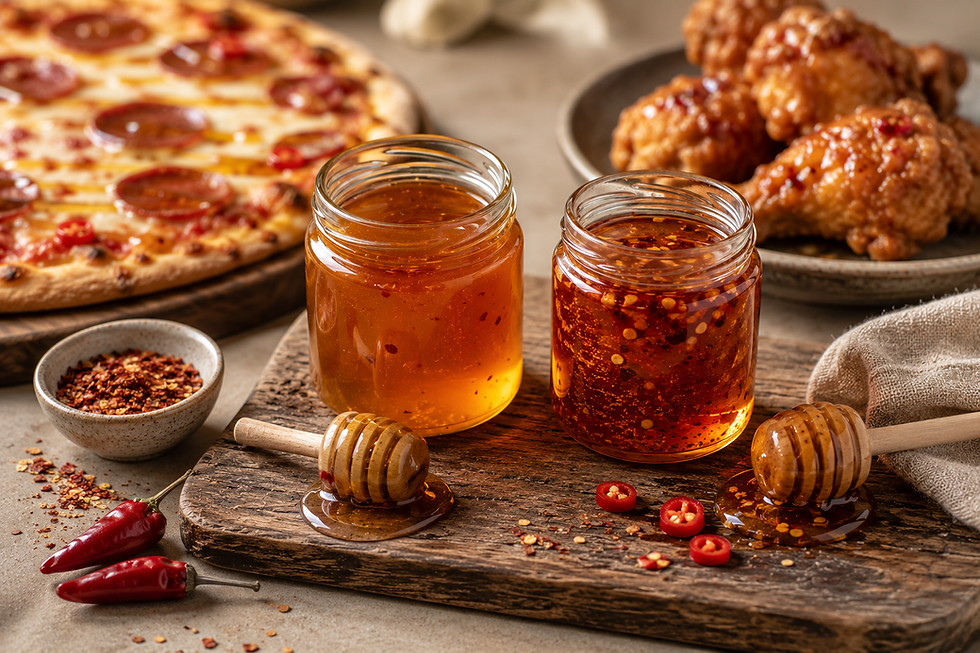
Are hot honey and chilli honey actually different?
Often, they are not. Both names cover a broad range, from softly warming honey to versions made for people who want a serious chilli kick. The label tells you how the maker has chosen to position the product; it does not guarantee a particular heat level or method. That is why the ingredient information and the maker’s tasting notes are more useful than the name alone.
What ‘hot honey’ usually promises
The term hot honey became especially familiar through American pizza, fried chicken and barbecue culture. It tends to sound bold, immediate and sauce-like: something to drizzle over salty, crisp or smoky food for an obvious sweet-and-spicy contrast. Plenty of hot honeys are mild, but the name often leads shoppers to expect heat to be the main event.
What ‘chilli honey’ usually suggests
Chilli honey puts the ingredient before the sensation. It can suggest a rounder flavour in which the character of the honey remains noticeable and the chilli follows with warmth. That makes the name feel at home beyond pizza and fried food: beside cheese, over roast vegetables, in a glaze or even on buttered toast. This is a convention rather than a rule, but it explains why two similar jars can be described differently.
How sweetness and chilli change a dish
Honey softens salt, while chilli cuts through rich cheese, meat and oil. A little acidity from tomato, lemon or vinegar stops the combination becoming cloying. For an easy test, drizzle 1–2 teaspoons of chilli honey over a 25–30 cm pepperoni, goat’s-cheese or roast-vegetable pizza as soon as it leaves the oven. Add less than you think you need, taste, then decide whether the next slice wants more.
How to choose the right jar
Start with the food you actually cook, then look at how the maker describes the heat and texture.
Think about the food: For pizza, burgers or fried chicken, you may want a punchier style with clearly described heat. For cheese, dressings, glazes and breakfasts, a gentler honey-forward style can be more versatile.
Check when the heat arrives: Some honeys feel hot immediately; others build gradually or leave a lingering warmth.
Notice the texture: A free-flowing honey is easy to drizzle, while a naturally thicker jar is especially good for spreading.
Do not treat heat or thickness as quality: Neither a hotter flavour nor a thicker texture is automatically better. Choose the style that suits how you will actually use it.
Why we call ours chilli honey
At The Lakes Infusion Co., chilli honey best describes what we are trying to make: sweetness first, followed by a comfortable chilli warmth rather than a dare. Our honey is raw and is never warmed above hive temperature; we prepare it in small batches in the Lake District. The name is deliberately straightforward, leaving the flavour to do the explaining. Use it wherever a dish needs contrast rather than simply more heat. The quickest place to begin is a piece of salty cheese, a tray of roast vegetables or that next pizza.